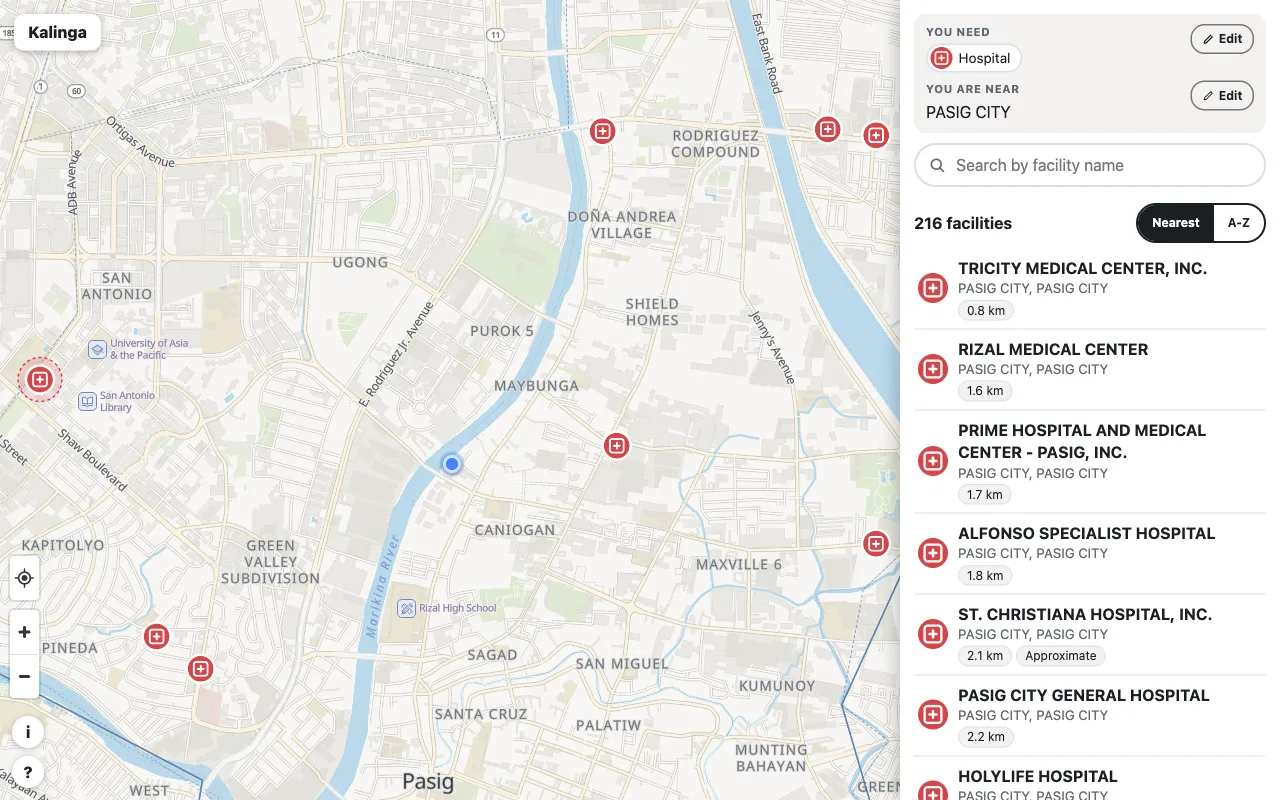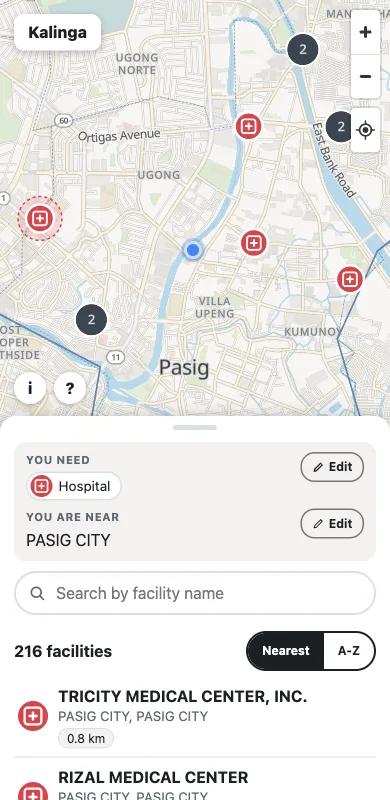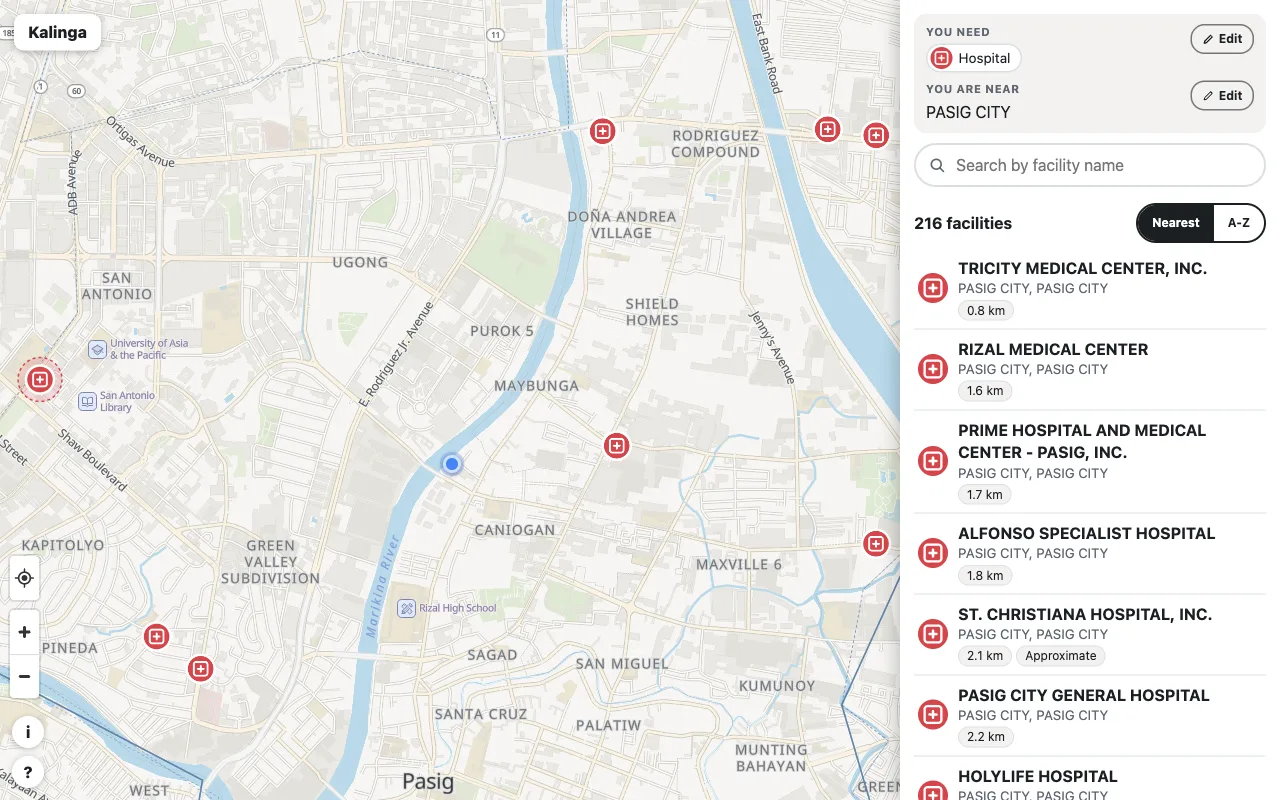
Kalinga showing hospitals near Pasig City on a map

Kalinga

ALPHA

Agentic, Maps, Open Data, Health

Roughly 14,000 PhilHealth-accredited facilities across 17 regions, searchable by what you need and where you are, nearest first.

Parsed PhilHealth's accredited-facility lists from various PDF files and geotagged the facilities so you can search by what you need and where you are, even on a phone and a slow connection. The closest matching facilities come first. It is an independent project and is not affiliated with PhilHealth.

Project Background

PhilHealth's accredited facilities are published as 26 usable PDF lists, one per program. Its own interactive map returned a 404 when I checked, and the page that pointed to it was down. The data exists, but it is locked in documents that are hard to search on a phone.
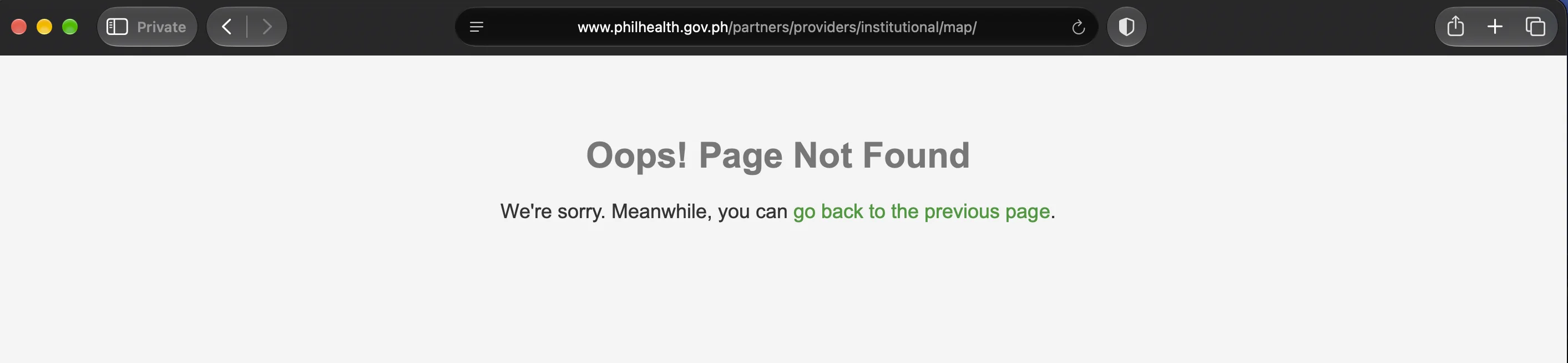
Browser at www.philhealth.gov.ph/partners/providers/institutional/map/ showing 'Oops! Page Not Found'
Checked 20 Nov 2026.

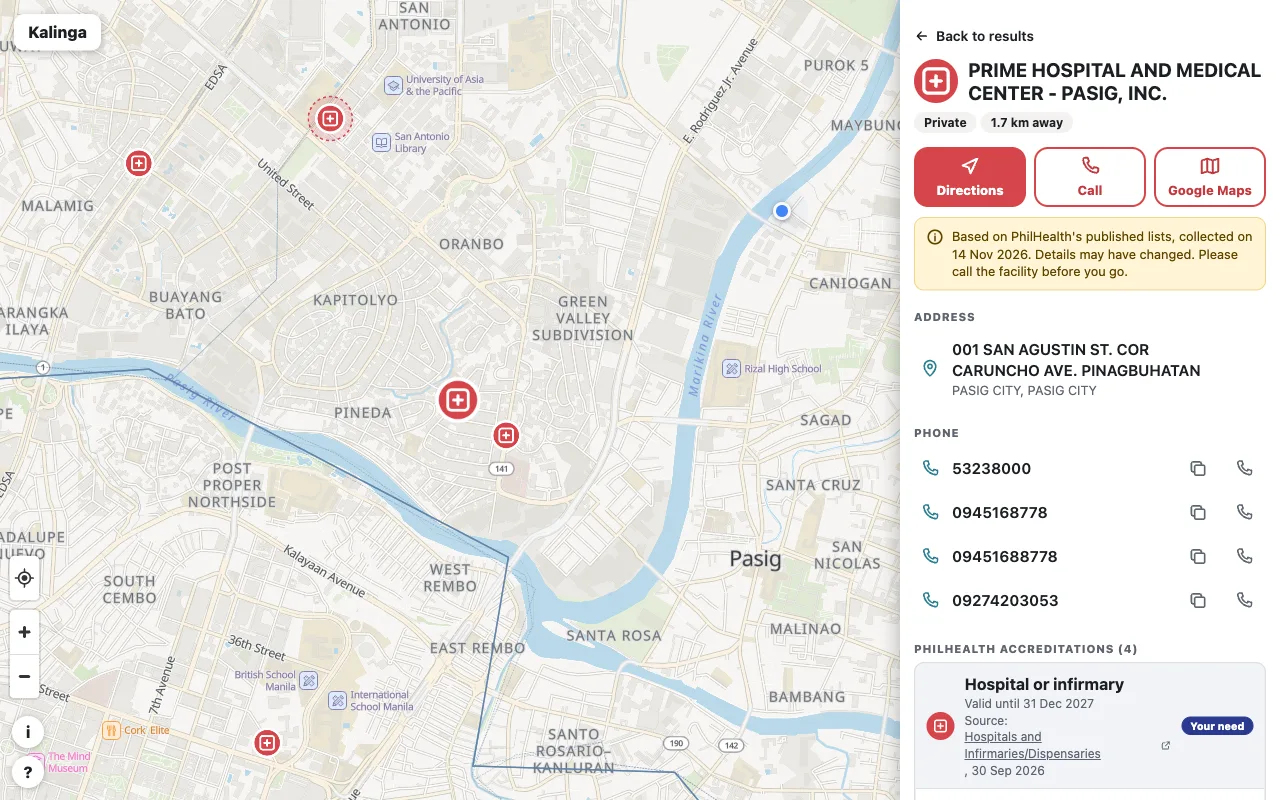
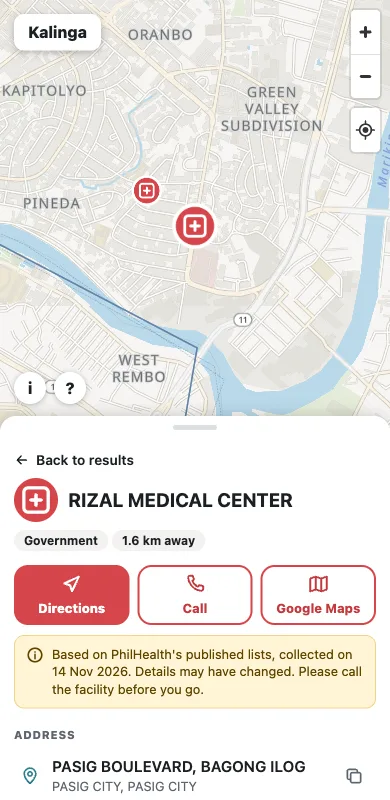
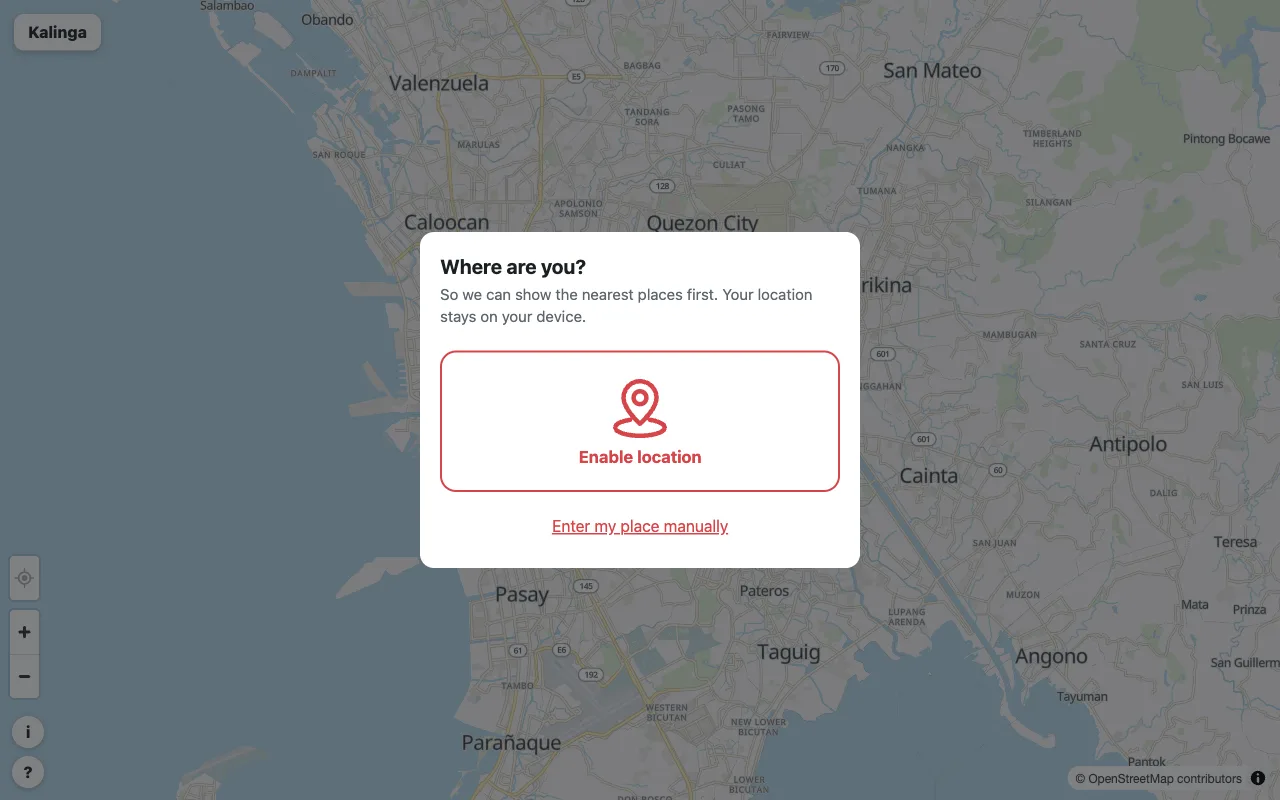
Kalinga turns those lists into a map. You pick what you need (a YAKAP clinic, dialysis, maternity care, dental, animal bite treatment), say roughly where you are, and see the accredited facilities that offer it, nearest first. Tap a pin for details, phone numbers, accreditation expiry and a link to directions.
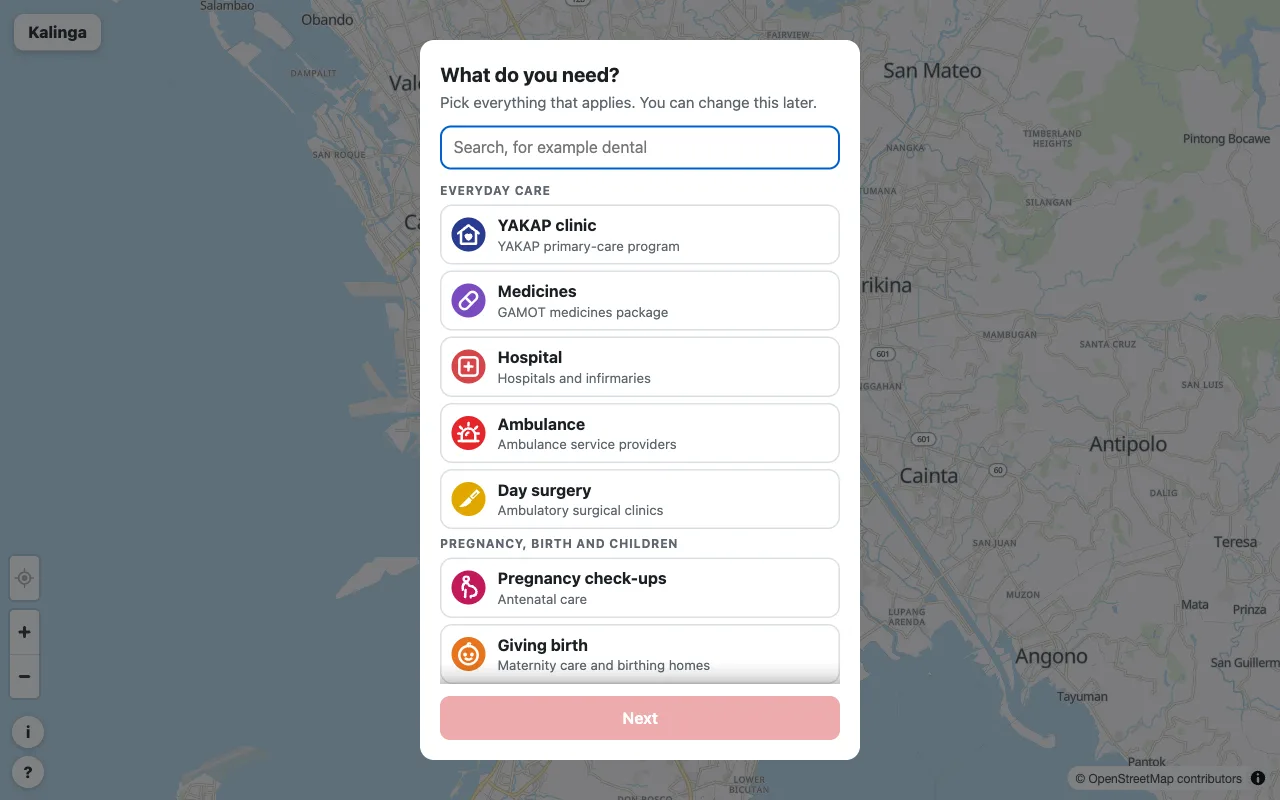
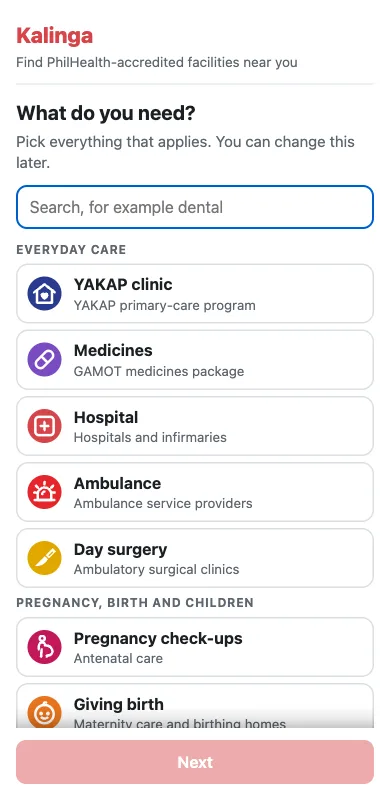
Kalinga's first screen: choose what you need from 21 plain-language needs in four groups

Who it's for

PhilHealth members and their families who need to know where their benefit can actually be used, and the people who help them: barangay health workers, social workers and patient advocates.

The language is plain on purpose. PhilHealth's program names are replaced by 21 "needs" in four groups, each with its own color and icon, checked for color-vision differences and never relying on color alone.

What it contains

  • 14,143 facilities in 17 regions, from 26 PhilHealth lists (the COVID-19 lists are left out on purpose).
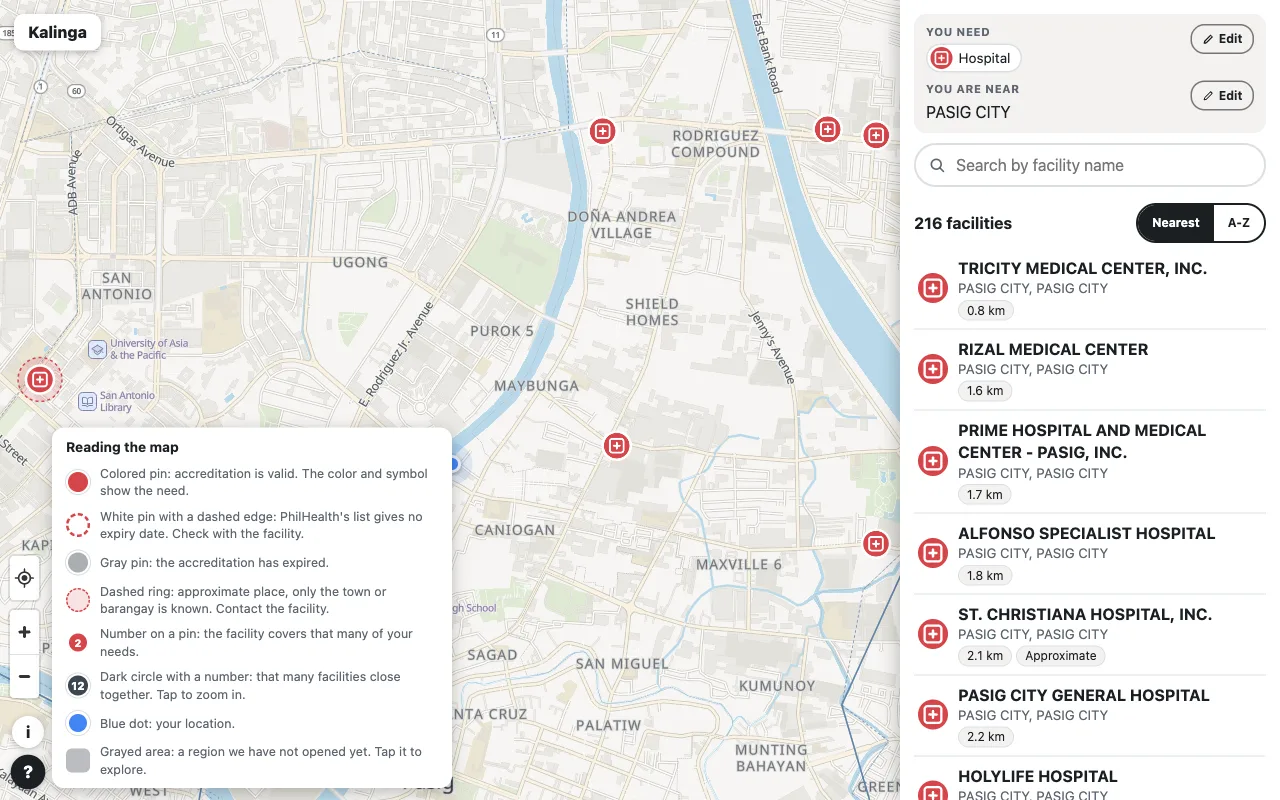
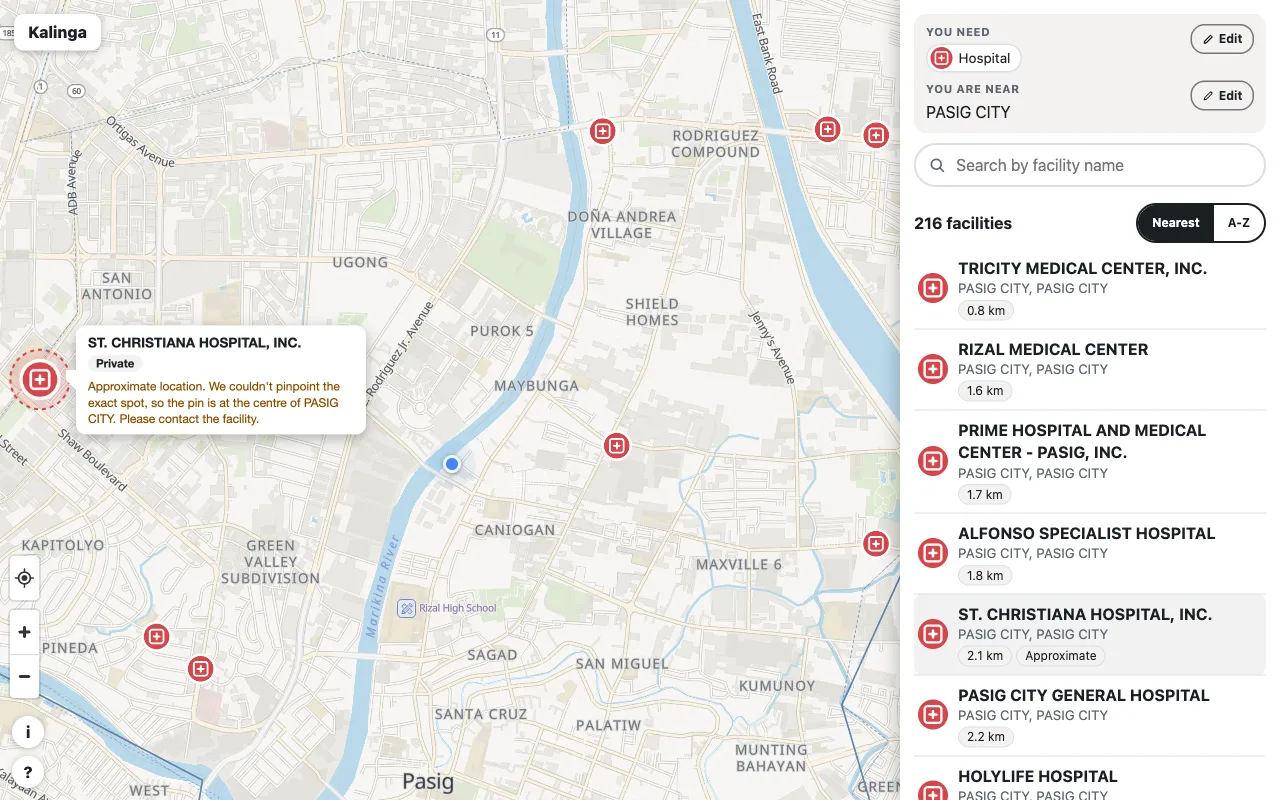
  • Locations come from geocoding each address: 39% at street level, 20% to the barangay and 41% to the town centre only. Approximate pins get a dashed ring and a "contact the facility" note instead of a false sense of precision.
  • Privacy by design: nothing about a person's needs or location is stored, put in the web address or sent anywhere.

Gaps in the source data

Each of these is shown to the user as a known gap, not hidden:

  • Birthing Homes (broken link). PhilHealth's accreditation page links to a Birthing Homes list at MCP_073126.pdf, but instead of a PDF it returns an HTML error page (checked 14 Nov 2026). The 26 other lists on the same page download fine, so birthing homes are missing from Kalinga until PhilHealth provides the file.
  • Newborn care (missing, not broken). There is no newborn-care list on the page at all, so there is no link to fix. Pregnancy care is covered; care for newborns is not.
  • PhilHealth's own interactive facility map URL returns 404.
  • Three lists (YAKAP, GAMOT, Cancer Screening) carry no date, so the app says "no date stated" instead of guessing.
  • Some PDF rows have e-mails broken across lines and phone fields holding two numbers; the pipeline repairs these.

Kalinga cannot publish birthing homes or newborn-care facilities without data from PhilHealth. Until then the gap is stated openly in the app.

How it was built

Kalinga was built with an AI coding agent (Claude Code), with me steering the decisions and reviewing the result:

  1. Brainstorm first: who it is for, the 21 needs, the privacy rules and hosting, written down before any code.
  2. Two design documents: one for the data and one for the interface, with mockups and a color-vision check.
  3. A 15-task plan, built test-first: PDF extraction, cleaning, merging, geocoding and a per-region JSON export, then a Preact and TypeScript app with MapLibre.
  4. Fresh-eyes review: a separate reviewer read the whole branch, and its important findings were fixed with tests before going on.
  5. Many short UI rounds, each checked in a real browser at desktop and phone sizes.
  6. A static stack: Protomaps vector tiles (about 760 MB of OpenStreetMap data) on Cloudflare R2 and the app on Cloudflare Pages. No server, no database, no accounts.

158 automated tests cover it, and the data pipeline can be re-run whenever PhilHealth updates its lists.

What's next

  • Birthing homes and newborn care. The plan to get the data:
    1. Ask PhilHealth in writing for the Birthing Homes list and a fix for the broken link, through its public contact channels and a freedom-of-information request.
    2. Ask whether a newborn-care accreditation list exists at all, and if so for a dated copy.
    3. Re-check the accreditation page on a schedule. The pipeline re-downloads every list, so a fixed link or a new list is picked up by re-running it.
    4. Publish only what PhilHealth supplies or publishes itself, never guesses from other sources.
  • Better locations. More facilities pinned to the building instead of the town centre (today 41% are town-centre only).
  • A possible separate project: facilities partnered with private health insurers (HMOs), for which no open cross-insurer dataset exists.

Screenshots

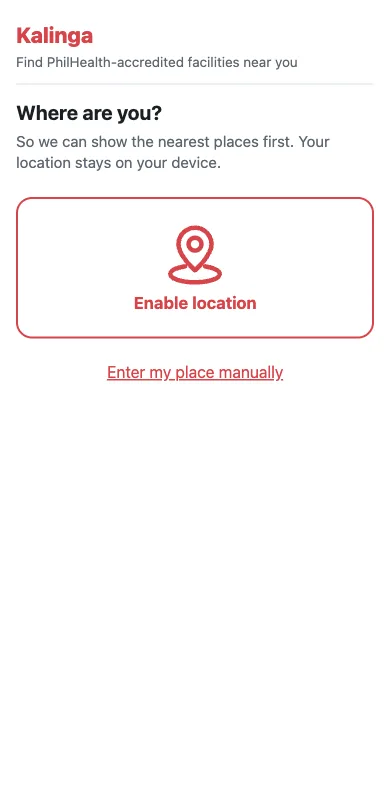
Kalinga's first screen: choose what you need from 21 plain-language needs in four groupsKalinga asking roughly where you are, by place name or device locationHospitals near Pasig City as pins on the map, with a nearest-first list beside itThe 'reading the map' legend explaining pins and approximate locationsA facility's details: phone numbers, accreditation expiry and a link to directionsHover card on an approximate pin, with a note to contact the facility
Choosing a need on a phoneSaying where you are on a phoneResults map and list on a phoneFacility details on a phone

Map data © OpenStreetMap contributors (ODbL); boundaries from OCHA (CC BY-IGO). Kalinga is independent and not affiliated with PhilHealth.

NOAH, Revamped!

Previous Project

ReliefAgad

Next Project

Interested in doing a project together?